


Blog
Safety Boots vs Safety Shoes vs Safety Trainers: Which Do You Actually Need?

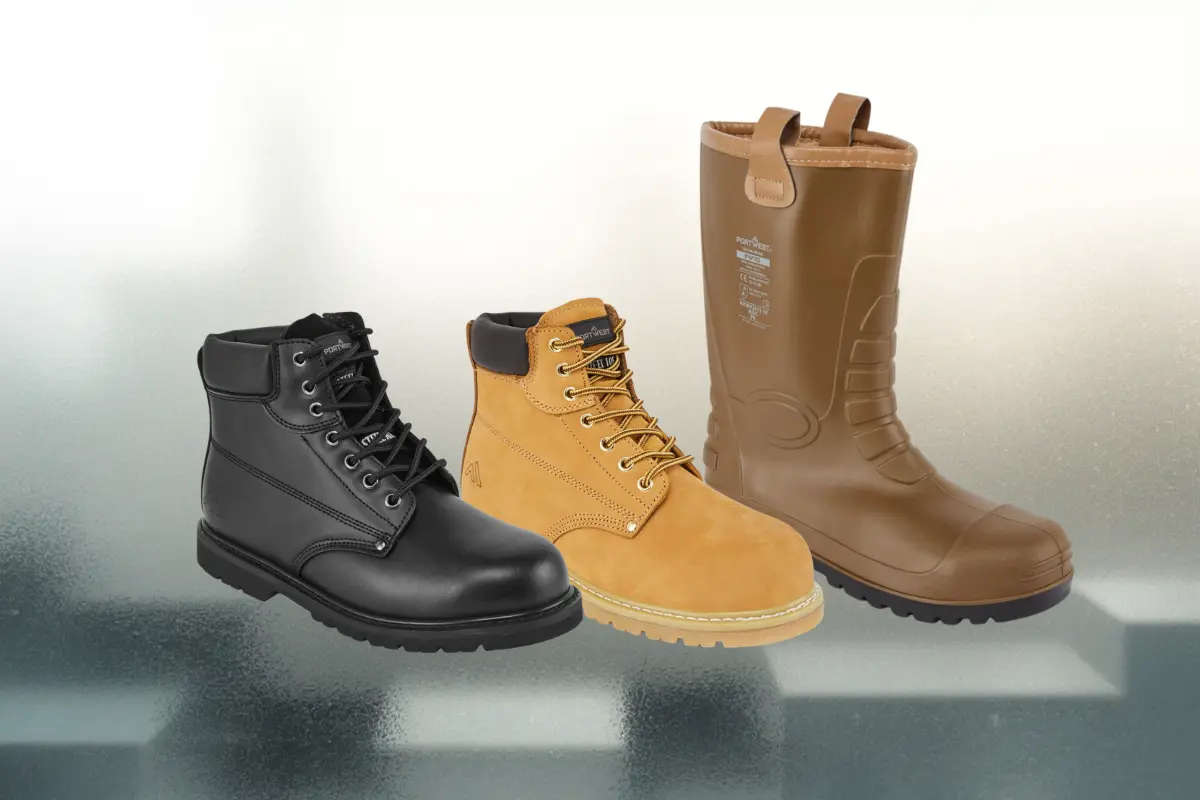
Walk into a safety footwear section and you will find boots, shoes, trainers, wellingtons, and overshoes, all labelled with a string of letters and numbers. S1P. S3. SRC. WR. Most buyers either pick the most familiar option or default to the heaviest boot they can find. Neither approach is right. Both can leave you with footwear that is either under-specified for the actual risk or far heavier and less comfortable than the job requires.
This guide cuts through the confusion. We explain what the ratings actually mean, what the physical differences between boots, shoes and trainers are, and, most importantly, how to match the right footwear to the right job. We also cover the EN ISO 20345:2022 standard update, which introduced new classification codes that are now appearing on products alongside the older 2011 markings.
The core principle that most guides miss: safety boots, safety shoes and safety trainers all sit under the same standard, EN ISO 20345. A pair of safety trainers can be rated S3, the same as a full-height construction boot. The form factor is a fit, comfort and practicality choice. The rating is the compliance and safety choice. These are separate decisions.
The Standard: EN ISO 20345 and What It Actually Means
All safety footwear sold in the UK must comply with EN ISO 20345, the international standard for safety footwear. Every pair must achieve at minimum a 200-joule toe impact resistance and 15 kN compression resistance, the equivalent of a 20 kg weight dropped onto the toes from just over a metre, and 1.5 tonnes resting on the toe cap. These are the baseline requirements for any item to carry the safety footwear designation at all.
Beyond that baseline, a coding system describes additional protections. This is where S1, S2, S3 and the various sub-designations come in. Understanding this system is the key to making a correct purchasing decision, because the right rating follows from a workplace risk assessment, not from personal preference.
The EN ISO 20345:2022 Update: What Changed
A revised standard, EN ISO 20345:2022, was published in 2023 and has been transitioning into the market since. The most significant changes for buyers are:
- Slip resistance is now a baseline requirement for all certified footwear, not an optional add-on. This means the old SRA, SRB and SRC markings no longer appear on footwear tested to the 2022 standard. An enhanced optional slip resistance test is now marked as SR.
- Two new classes, S6 and S7, have been added. S6 is equivalent to the old S2 plus full water resistance across the whole shoe. S7 is equivalent to the old S3 plus full water resistance. Buyers who previously looked for S2 or S3 with a WRU marking should now look for S6 or S7 respectively.
- Puncture resistance markings for non-metallic midsoles have been refined. The P marking is now reserved for metal puncture-resistant insoles. Non-metallic variants are marked PL (tested with a 4.5 mm nail) or PS (tested with a smaller 3 mm nail, representing a tougher standard).
- The LG (ladder grip) marking has been introduced to indicate footwear tested for use on ladder rungs, relevant for anyone working regularly at height.
Important for buyers: EN ISO 20345:2011 certificates remain valid until their individual expiry date, which is up to five years from the certification date. Some footwear on the market may still carry 2011 markings through to 2026 or 2027. This is compliant and legal. What you should not accept is footwear with no EN ISO 20345 certification at all, or products claimed to be certified that lack the UKCA or CE marking confirming they have been third-party tested.
The Rating System Explained
The table below covers the ratings you will encounter most often. Ratings build on each other: S2 includes everything in S1, S3 includes everything in S2, and so on.
| Rating | What it includes | Typical use |
| SB | 200J toe cap only. Baseline protection. No antistatic, no energy absorption. | Rarely specified in practice. Minimum possible. |
| S1 | SB + closed heel + antistatic properties + energy absorption in the heel seat. | Light indoor work on dry, clean surfaces. |
| S1P | S1 + metal puncture-resistant midsole (resists 4.5 mm nail). | Warehousing, light manufacturing, maintenance where nails/screws are present. |
| S1PL / S1PS | S1 + non-metallic puncture midsole. PL = larger nail test; PS = smaller nail (tougher standard). | Lighter alternative to S1P where metal-free footwear is needed (e.g. airport security areas, food production). |
| S2 | S1 + water penetration and absorption resistance of the upper (WPA marking under 2022 standard). | Environments where occasional water or moisture is present but ground is not consistently wet. |
| S3 | S1P + upper water resistance + cleated outsole. The most widely specified outdoor standard. | Construction sites, outdoor maintenance, groundwork, agriculture, loading bays. |
| S3L / S3S | S3 with non-metallic puncture midsole variants (PL or PS). Metal-free equivalent of S3. | As S3, where metal detection or medical environments require non-metallic footwear. |
| S6 (new 2022) | S2 + full shoe water resistance (WR). Whole shoe tested, not just upper. | Outdoor work in consistently wet conditions where water resistance across the entire shoe is needed. |
| S7 (new 2022) | S3 + full shoe water resistance (WR). Replaces S3+WRU combination. | Heavy outdoor work in rain, mud, standing water. Equivalent to the previous S3+WRU combination. |
| SR (optional, 2022) | Additional enhanced slip resistance test on glycerine-coated tile. Equivalent of the old SRC marking, on a harder test. | High-risk slip environments: food production, hospitality kitchens, wet factory floors. |
Boots, Shoes or Trainers: What the Form Factor Actually Changes
Now for the part most guides conflate with the rating system, when it is actually a separate question. The form factor (boot, shoe or trainer) affects fit, ankle support, weight, breathability and job suitability. It does not determine protection level. A safety trainer can carry an S3 rating. A safety shoe can carry S1P. You are choosing a form factor based on your working conditions, not choosing a level of protection.
Safety boots
Safety boots extend above the ankle, typically to mid-calf. The higher cut provides ankle support and protection against rolling on uneven ground, debris entering over the top of the shoe, and some protection against ankle-height impacts. This makes them the right choice for outdoor construction, groundwork, quarrying, heavy logistics, and any environment where the ground surface is rough, uneven, or heavily contaminated.
The trade-off is weight and heat. A full S3 safety boot is considerably heavier than a safety trainer with the same rating. For workers doing high step counts on flat, clean surfaces (warehouse operatives, for instance), the fatigue from wearing over-specified footwear all day has its own cost in productivity and injury risk.
Safety shoes
Safety shoes are low-cut, covering the foot but not the ankle. They are lighter, easier to put on and take off, and more comfortable in sedentary or mixed-environment roles. They are the standard choice for light manufacturing, retail environments with occasional manual handling, food production, healthcare support roles, and any job that requires moving between office and operational environments.
The limitation is ankle protection and water ingress. If the work involves consistently wet ground, rough terrain, or any risk of materials falling onto the foot from above ankle height, a shoe provides less protection than a boot.
Safety trainers
Safety trainers meet the same EN ISO 20345 standard as boots and shoes. The difference is construction and aesthetics: they use materials and profiles associated with athletic footwear: mesh uppers, foam midsoles, lighter outsoles. This makes them appreciably lighter and more breathable, and for many roles they are the most appropriate choice.
They are the natural fit for delivery drivers who spend long hours alternating between driving and walking, for warehousing staff on flat concrete surfaces, and for any role where the risk profile does not require the ankle support or waterproofing of a full boot. They are also increasingly specified in roles where appearance matters, such as customer-facing logistics or hospitality environments with some manual handling.
What to check when buying safety trainers: ensure the rating matches your risk assessment, not just the style. A safety trainer with an S1 rating is not appropriate for outdoor construction. A safety trainer with S3 or the new S7 rating, and a genuine UKCA/CE mark confirming EN ISO 20345:2022 (or still-valid 2011) certification, provides the same level of toe and midsole protection as any full boot with the same marking.
The Decision Table: Matching Footwear to Environment
Use this as a starting point, not a substitute for a site-specific risk assessment. The risk assessment remains the legal basis for the footwear requirement under PPER 2022.
| Environment / Role | Recommended rating | Best form factor |
| Construction: groundwork, civils, demolition | S3 or S7 | Full boot with ankle support and cleated sole |
| Construction: finishing trades and fit-out | S1P or S3 | Boot or shoe depending on site conditions |
| Warehousing: heavy goods, forklift environment | S1P minimum | Boot or safety shoe; trainer if flat surface confirmed |
| Warehousing: light pick and pack, dry flat floors | S1P | Safety trainer often appropriate |
| Outdoor maintenance, facilities management | S3 or S7 | Boot in most cases; shoe if predominantly dry and flat |
| Delivery driving, couriers | S1P | Safety trainer typically right for this role |
| Food production, hospitality kitchens | S1P or S3, SR for slip resistance | Low-cut safety shoe or clog; slip resistance is the priority |
| HGV drivers: in-cab and yard operations | S1P minimum | Boot or safety shoe; hi-vis and PPE package to match |
| Light manufacturing, assembly | S1P | Safety shoe or trainer; metal-free (PL/PS) if required |
| Healthcare, laboratory, clean room | S1PL or S1PS (metal-free) | Safety shoe or clog; easy to clean |
| Agriculture, outdoor fieldwork | S3 or S7, Wellington if standing water | Boot required; S7 or safety wellington for wet ground |
The Employer’s Legal Position
Safety footwear for employees is not a matter of discretion. The Personal Protective Equipment at Work Regulations 1992, as amended by PPER 2022, require employers to provide appropriate PPE free of charge to all workers (including, since April 2022, limb (b) workers such as agency staff, casuals, and temporary employees) where a risk assessment identifies a hazard that cannot be fully controlled by other means.
The risk assessment is therefore the document that drives the footwear specification. It should identify the specific hazards: falling objects, sharp projections underfoot, wet surfaces, chemical exposure, electrical risk. The specification follows from those hazards. An employer who specifies S1 footwear for a worker on an outdoor construction site because it is cheaper has not discharged the duty. An employer who specifies S3 boots for a desk-based role that occasionally involves walking through a warehouse has over-specified, and may face complaints about comfort and wearability.
One common compliance gap: the employer buys compliant footwear and then hands responsibility to the employee. PPER 2022 also requires employers to maintain PPE in good repair and to replace it when it is no longer fit for purpose. A safety boot with a cracked toe cap or a delaminating sole is not compliant PPE, regardless of its original rating. Operators who run fleets or large workforces should have a documented footwear inspection and replacement process in place.
A Note on the 2022 Standard and Products You May See
If you are purchasing footwear now, you will encounter a mix of products. Some carry EN ISO 20345:2011 certification, which remains valid until the certificate expires. Some carry EN ISO 20345:2022 certification. Both are compliant for current purchase, provided the certificate has not expired and the product carries a valid UKCA or CE mark.
Where the 2022 standard creates practical differences for buyers: if you are specifying S3 footwear for wet outdoor environments and want the highest level of water resistance available, look for S7 under the 2022 marking. This replaces the previous S3+WRU combination and is tested to a stricter standard. For the same reason, older SRC markings (visible on 2011-certified products) indicate footwear that passed enhanced slip resistance testing and remain valid for their certificate life; the equivalent under 2022 is the optional SR marking.
[INTERNAL LINK: Safety Boots category] | [INTERNAL LINK: Safety Shoes category] | [INTERNAL LINK: Safety Trainers category]
Frequently Asked Questions
Are safety trainers as safe as safety boots?
Yes, if they carry the same EN ISO 20345 rating. A safety trainer marked S3 provides the same toe impact resistance, midsole puncture protection, and upper water resistance as an S3 boot. The difference is form: the trainer lacks the ankle support and higher cut of a boot. For environments where ankle support and protection from material entering above the ankle are important (outdoor construction, groundwork, heavy haulage yards), a boot is the more appropriate choice. For flat, indoor, or low-risk environments, a properly rated safety trainer is entirely correct.
What does S1P mean on safety footwear?
S1P means the footwear meets the S1 specification (closed heel, antistatic properties, energy absorption in the heel) plus a metal puncture-resistant midsole (P). This is one of the most commonly specified ratings for warehousing, light manufacturing and maintenance environments. Under the EN ISO 20345:2022 standard, S1PL and S1PS indicate non-metallic puncture-resistant midsoles tested to two different nail sizes. Both provide puncture protection but without the metal insert, which matters where metal detection or food safety requirements apply.
What is the difference between S3 and S7 safety boots?
S3 is the established outdoor standard: closed heel, antistatic, energy absorption, metal puncture-resistant midsole, water-resistant upper (tested on the upper material only), and a cleated outsole. S7 is a new classification introduced in EN ISO 20345:2022 and adds full water resistance across the entire shoe, not just the upper, to all the S3 protections. If you previously specified S3 with a WRU (water-resistant upper) marking, the 2022 equivalent is S7. For consistently wet or muddy outdoor work, S7 provides better protection.
Do I need to pay VAT on safety boots?
Individual workers buying safety footwear for personal use do not pay VAT. This is a specific UK VAT relief that applies to protective boots (footwear with a protective toecap) when purchased by an individual for their own use at work. Employers buying footwear in bulk for employees pay the standard VAT rate. The relief applies to the item itself, not to insoles, socks, or accessories.
How often should safety footwear be replaced?
There is no fixed regulatory interval, but the legal obligation under PPER 2022 is that PPE must be maintained in good condition and replaced when it is no longer fit for purpose. Practically, this means inspecting footwear regularly for delamination of the sole, cracking or compression of the toe cap, deterioration of the upper, and breakdown of the midsole cushioning. A heavily used pair of safety boots on a construction site may need replacing every six to twelve months. Lighter-use footwear in an office or warehouse may last considerably longer. The test is condition, not age.
What safety footwear do HGV drivers need?
HGV drivers should carry safety footwear that covers both in-cab periods and yard or loading bay operations. S1P is typically the minimum appropriate specification, providing toe protection and puncture resistance for yard environments. For drivers working in consistently wet loading conditions, S2 or S3 is more appropriate. The employer’s risk assessment should confirm the specification. The footwear should always be accessible. Drivers who remove their safety footwear while driving and step out onto a yard in trainers are creating a compliance and safety gap that the employer is responsible for closing.